

Kaitiakitanga Assisted Dying Pathway
“We are all on this journey together”
SHORT
ON TIME?
Click here
to read a
summary
SHORT ON TIME?
Click here to read a summary
Māori whānau experiences of using assisted dying services in Aotearoa New Zealand
A Māori cultural view of assisted dying
One well known pūrākau (story) that supports mana motuhake is the story about Hine Tītama. First born female, Hine Tītama, used her mana motuhake (autonomy) to transform herself from her physical form into her wairua (spirit) form. When Hine Tītama realised her husband was also her father she became broken hearted; she used her mana (status, prestige) to make the decision to travel to the underworld and transform herself into Hine-Nui-Te-Pō. Before she left the physical realm, she instructed Tane, her children’s father, to care for them in her absence – she promised to wait for them in the underworld. Hine Tītama then transformed herself into the goddess of the underworld, the Maiden of Death.
Some iwi (tribes) believe that Hine Tītama’s aunty Hineruakimoa protectively watched over her as she passed through the portal leading to the underworld (heavenly realms). Hineruakimoa was an important kaitiaki (guardian). The whānau we interviewed in the Waerea study were very much like Hine Tītama’s aunty – they were kaitiaki who protectively watched over the person they loved as they travelled the assisted dying pathway to be with their atua and tūpuna. They cared for the terminally ill person and they protected them from any potential harm or discrimination associated with assisted dying.
Introduction
We draw on the lived experiences of whānau who participated in the Waerea study: Māori whānau experiences of using assisted dying services. Our shared aim is to support whānau to feel confident discussing assisted dying with a whānau member who has expressed an interest in having an assisted death. Reading stories from from others who have walked the same pathway will help whānau consider all aspects of assisted dying.
The names of the people we interviewed in the Waerea study are pseudonyms (confidential names) that the participants chose. Whānau told us that it was vitally important that the seriously ill person’s mana motuhake (autonomy and independence) was respected and that whānau who supported them on the assisted dying pathway felt safe. For more information about the study and the people we interviewed view, click here.
Ka tō a Tama-nui-te-rā, ka rere a Hina
When the sun sets, the moon rises.
Kaitiakitanga Assisted Dying Pathway
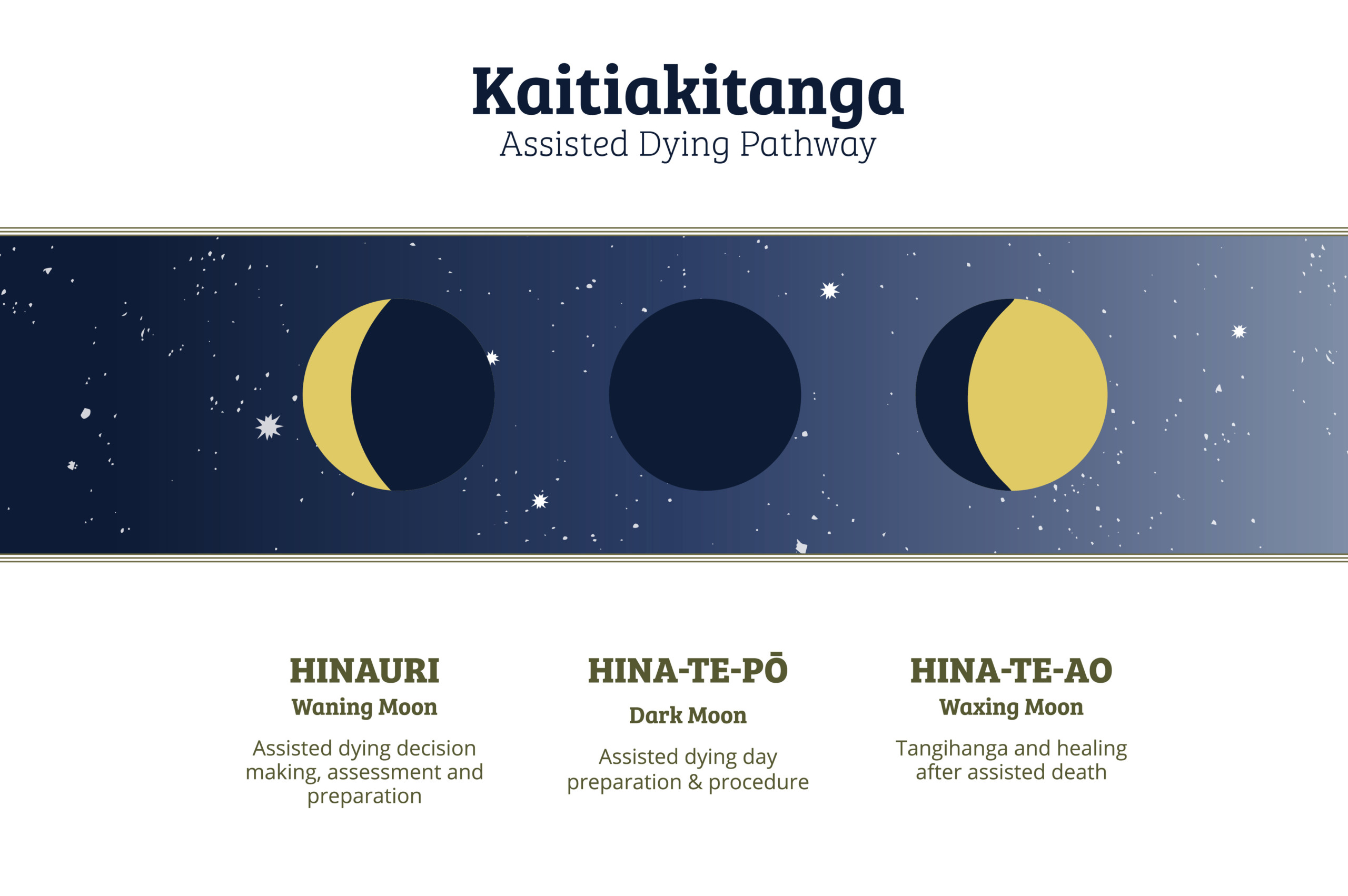
Whānau navigate three phases on the Kaitiakitanga Assisted Dying Pathway. Each phase is tied to a specific time during the assisted dying process. We draw on the gentle passage of the moon as it transitions through its natural cycle to illustrate the Kaitiakitanga Assisted Dying Pathway.

Whānau Kaitiaki
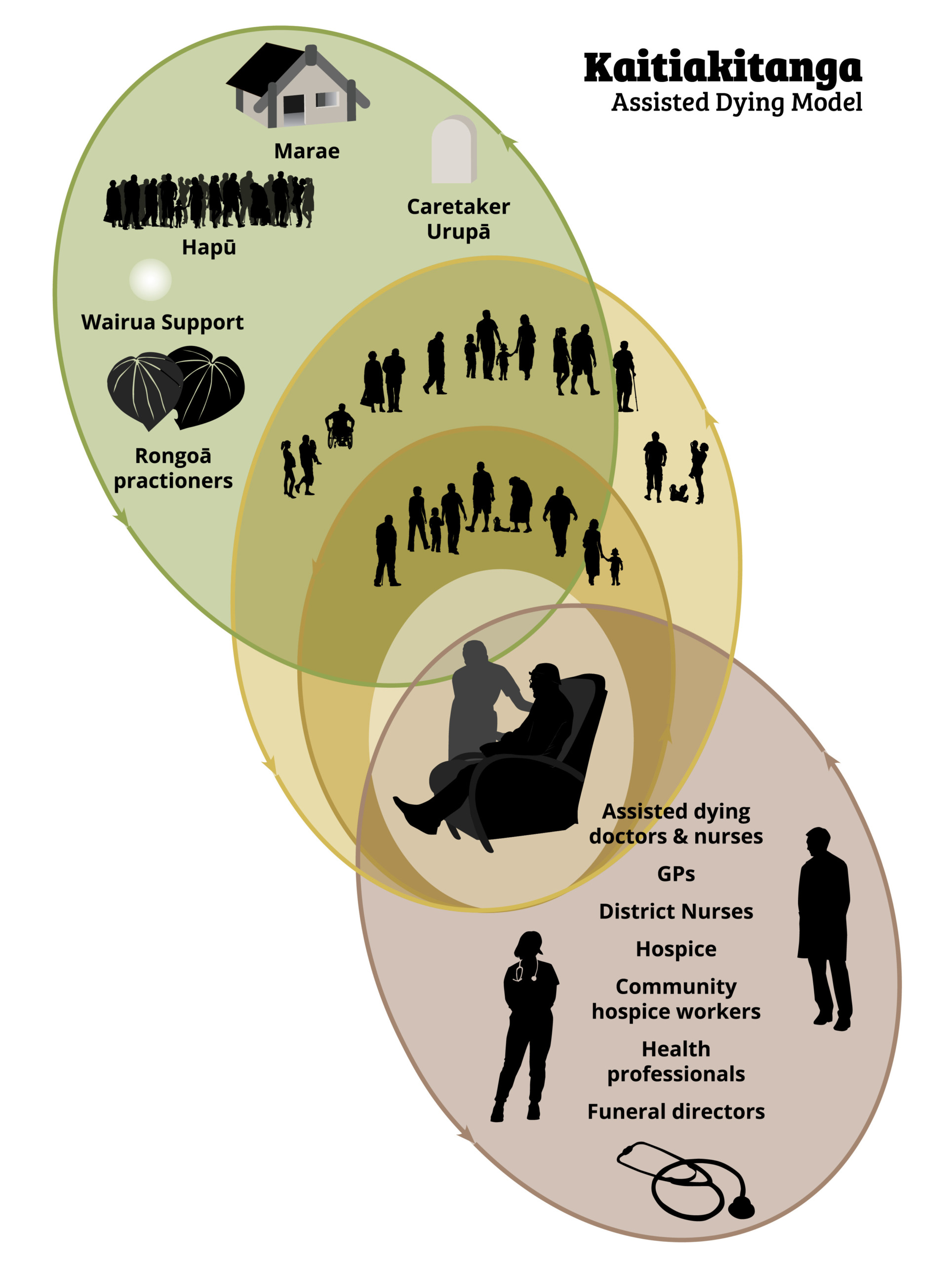
The Waerea study findings revealed that a person who had a terminal illness often only told one, two or a few whānau (family including extended family and friends) about their intention to have an assisted death. These whānau members became their trusted kaitiaki. They walked alongside the person, supporting them to achieve their mana motuhake (autonomy, independence) in death, as they lived in life. At times this meant helping the person to monitor who was told about the assisted death as privacy was important to them; the often feared discrimination and judgement from others. The kaitiaki also supported broader discussions with whānau. Other whānau members were told about the assisted death as the illness progressed; some may have attended the assisted dying procedure. Whānau helped organise and plan tangihanga and carried out death customs; they would often engage with iwi and hapū and mana whenua to organise wairua support, rongoā support and tangihanga. However, it was only those kaitiaki closest to the person who often attended the assisted dying assessments and knew the intimate details of the assisted dying process. Whānau often provided the bulk of support at palliative care at the end of someone’s life.
GPs, hospice staff and other health professionals became more involved with the person’s palliative care as their illness progressed and their health declined. The assisted dying medical practitioner and assisted dying nurse practitioners became more involved as the assisted dying day drew nearer. Also, closely involved with the person at end of life were Funeral Directors; they had an important role to play. Many people made their funeral arrangements before the assisted death. Caretakers in charge of urupā (cemeteries) were also approached prior to the dying day to make internment arrangements.
Key point: Many people were involved in supporting the person who had a terminal illness at their end of life however, often only a few close and trusted whānau walked closely alongside the person who had the assisted death, and they were crucial in supporting them to navigate the assisted dying pathway.
Hinauri - Phase 1. Brief introduction and overview
When a loved person in the whānau chooses the path of assisted dying, whānau step into the gentle twilight of Hinauri, the waning moon. This is a time of tending and deep care when the light begins to fade but its warmth still lingers. Hands are busy, hearts are full, and silence carries a sacred hum. It is a phase of manaakitanga (caring), of kaitiakitanga (guardianship), of holding fast to the one whose wairua (spirit) prepares to journey toward Te Pō (the night). Hinauri, the first phase marks the journey from the time of discovery of the terminal illness and the desire to explore the option to have an assisted death until the time of the assisted dying procedure. Whānau become kaitiaki (guardians) providing manaakitanga, protection, advocacy and support following a life limiting diagnosis and before the assisted death. This phase reflects the important role of whānau who are invited to walk alongside the terminally ill person on the assisted dying pathway. As kaitiaki, whānau help the terminally ill person navigate the Kaitiakitanga Assisted Dying Pathway.
Whānau provide aroha, manaakitanga and kaitiakitanga the moment the person expresses a desire to have an assisted death. Their support continues throughout the assisted dying assessment phase and during the discussions the person has with health professionals and extended whānau and friends. Leah (sister-in-law) said, “Our role was honouring his life talking about assisted dying.” Support includes carrying out palliative care, planning and preparing for the assisted dying day and tangihanga (funerals).
Hina-te-pō - Phase 2. Brief introduction and overview
Following Hinauri (Phase 1) comes Hina-te-pō, the dark moon. The familiar light disappears, and whānau find themselves surrounded by uncertainty. Questions echo about choice, about tikanga, about the meaning of such an ending. Yet within this darkness, the seeds of understanding begin to stir. Though unseen, transformation is taking place. The absence of light is not the end; it is the space where renewal gathers strength. Hina-te-pō, the second phase marks the journey into the time of the assisted dying procedure, and it continues until the completion of the procedure. Whānau help plan, prepare and provide support on the assisted dying day. This phase involves whānau supporting the person with a terminal illness to organise and conduct everything according to their wishes prior to, and on the day of the assisted dying procedure.
Whānau plan and prepare everything that is needed for the assisted dying day. This can include arranging a special gathering where the person can farewell their whānau before the assisted death. On the dying day whānau support the person by caring for them and upholding tikanga (cultural customs). They make sure everything is in place and everyone is present who needs to be there.
Whānau attend to arrangements involving funeral directors, tangihanga and the internment of the tūpāpaku (body). Information about the assisted dying date and time are often limited to specific whānau members to uphold the privacy of the loved person. Jackie-X (sister) commented it is important, “to whakamana their wishes” at the end of life:

And I think the overpowering part was that it was the love of our brother. This is what he chose and we love each other… so you know if he said he wanted a tangi in an aeroplane [we would have given it to him] (Jackie-X, sister)
Hina-te-ao - Phase 3. Introduction and overview
In time, Hina-te-ao rises again, the waxing moon returning to the night sky following Hina-te-Pō. Slowly, clarity replaces confusion, and grief begins to soften. Whānau come to see that death too, follows a rhythm written into the cosmos. The journey of their loved one, though painful, is held within a larger pattern of light and darkness, of descent and return. Like Hina herself, who moves through shadow and re-emerges luminous, the whānau learn that love continues its orbit long after the sun has set. Hina-te-ao, the third phase marks the time following death and includes Māori post-death customs including tangihanga and encompasses whānau bereavement. Whānau pani (bereaved family) oversee post-death tikanga and tangihanga (funeral customs). This phase includes everything that whānau are involved with that supports and oversees the care of person’s tūpāpaku (body) and the wairua (spirit) after they die including conducting their tangihanga [funeral customs] and ensuring the person’s wishes are upheld with regards to burial or cremation.
Whānau have the responsibility to care for the person’s wairua and body after they die. Whānau support tikanga (cultural customs) that are required and they participate in arranging care of the tūpāpaku (body), tangihanga (funeral customs) and the nehu (burial) or cremation. During this time, they often refrain from telling people about the assisted death to protect the privacy and mana of their loved person who has died. After the tangihanga has finished whānau often reflect on their loss and grief for the first time and they consider their own healing; they try to make sense of their experiences.

Nanipā’s Choice
Mana Motuhake in life and death
Nanipā’s Choice is a fictional story about Nanipā Hemi’s choice to have an assisted death. Volunteer actors and actresses and graphic illustrations illustrate some of the issues that arise for Nanipā and his whānau. More information about the story is provided at the back of the book.
Ka tō a Tama-nui-te-rā, ka rere a Hina
Every ending brings its own rising.