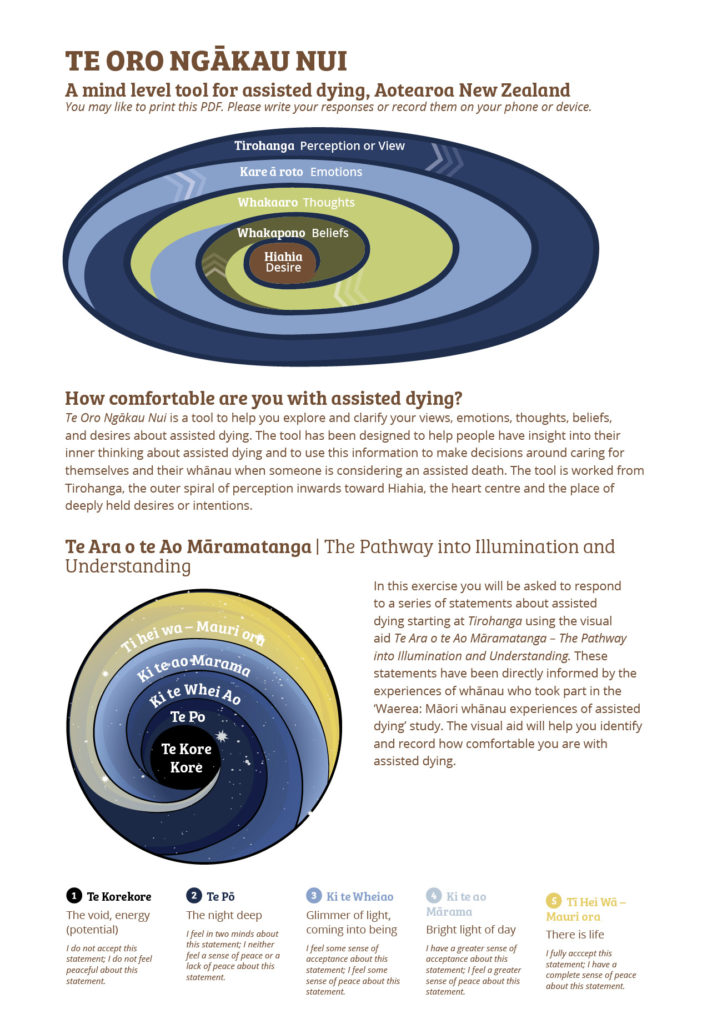

Te Oro Ngākau Nui
A mind level tool for assisted dying, Aotearoa New Zealand
Authors Tess Moeke-Maxwell, Margaret Sandham, Linda Nikora, Jessica Young, Brianna Smith, Gary Cheung, Annabel Ahuriri-Driscoll, Te Hurinui Karaka-Clarke, Suzanne Geurin
Introduction
Te Oro Ngākau Nui was conceptualised by Dr Tess Moeke-Maxwell (lead researcher, Waerea study) to help individuals and their whānau consider often complex thoughts, feelings and beliefs that can arise when someone we care about considers or uses the End of Life Choice Act (EoLC) (2019). The EoLC Act (2019) is a New Zealand statute that provides a legal framework for assisted dying for some people with a terminal illness who meet the strict eligibility criteria. It was passed by Parliament in 2019, approved by binding public referendum at the 2020 general election, and came into force on 7 November 2021.
The statements used in Te Oro Ngākau Nui have been directly informed by the experiences of whānau who took part in the Waerea assisted dying study. Whānau told us they wanted to uphold and support the mana motuhake (autonomy, independence) of their whanaunga (relative) to have an assisted death even though they may not have voted for the EoLC Act (2019) or considered this option themself. The term ‘assisted dying,’ referred to in law and policy, is the legal process under the EoLC Act (2019) whereby an eligible person with an incurable terminal illness can legally end their life with medical assistance. The person has to undergo two assessments by an assisted dying doctor to determine eligibility; they have to meet all the criteria.
The name Te Oro Ngākau Nui means ‘close to one’s heart.’ It was gifted by Whio Wharemate Hansen (Te Ārai Kāhui). In this conceptualisation, ‘Te Oro’ is an echo or vibration of the heart. This vibrational frequency reflects the mauri (energy life force) that lives inside everyone. Talking about death and dying can be very emotional. When we feel comfortable about assisted dying, we are more likely to have a peaceful mauri however, our mauri will feel unsettled if we are uncomfortable with being involved. The idea was inspired by a tool developed by David Hoffmeister to support people to find peace .
Consideration is given to caring for everyone who is travelling on the Kaitiakitanga Assisted Dying Pathway. For example, some people may feel completely at ease with assisted dying. They may feel comfortable attending assisted dying assessments and being present during the procedure. However, others may feel uncomfortable with the idea of assisted dying, and they may not want to attend the assisted dying procedure. Respecting how everyone thinks and feels will help whānau supportively discuss assisted dying in a safe and mana-upholding way.
The Te Oro Ngākau Nui exercise can open discussions about how comfortable people feel about assisted dying. The tool can be completed individually or together as a whānau, or as part of a community wānanga.